Skip to content
the work between your tools runs on its own.
for companies, institutes and hospitality businesses whose setup grew faster than anyone could plan it.
the tools in most businesses were added one at a time, whenever the next one was needed, and each of them works well on its own. nobody planned what happens between them.
so the steps in between are done by hand. information is typed from one tool into the next, messages are forwarded until they reach the right person, and follow-ups depend on someone remembering them. none of it is difficult, and all of it lands on the same person, every day.
the operating system is the layer between your tools.
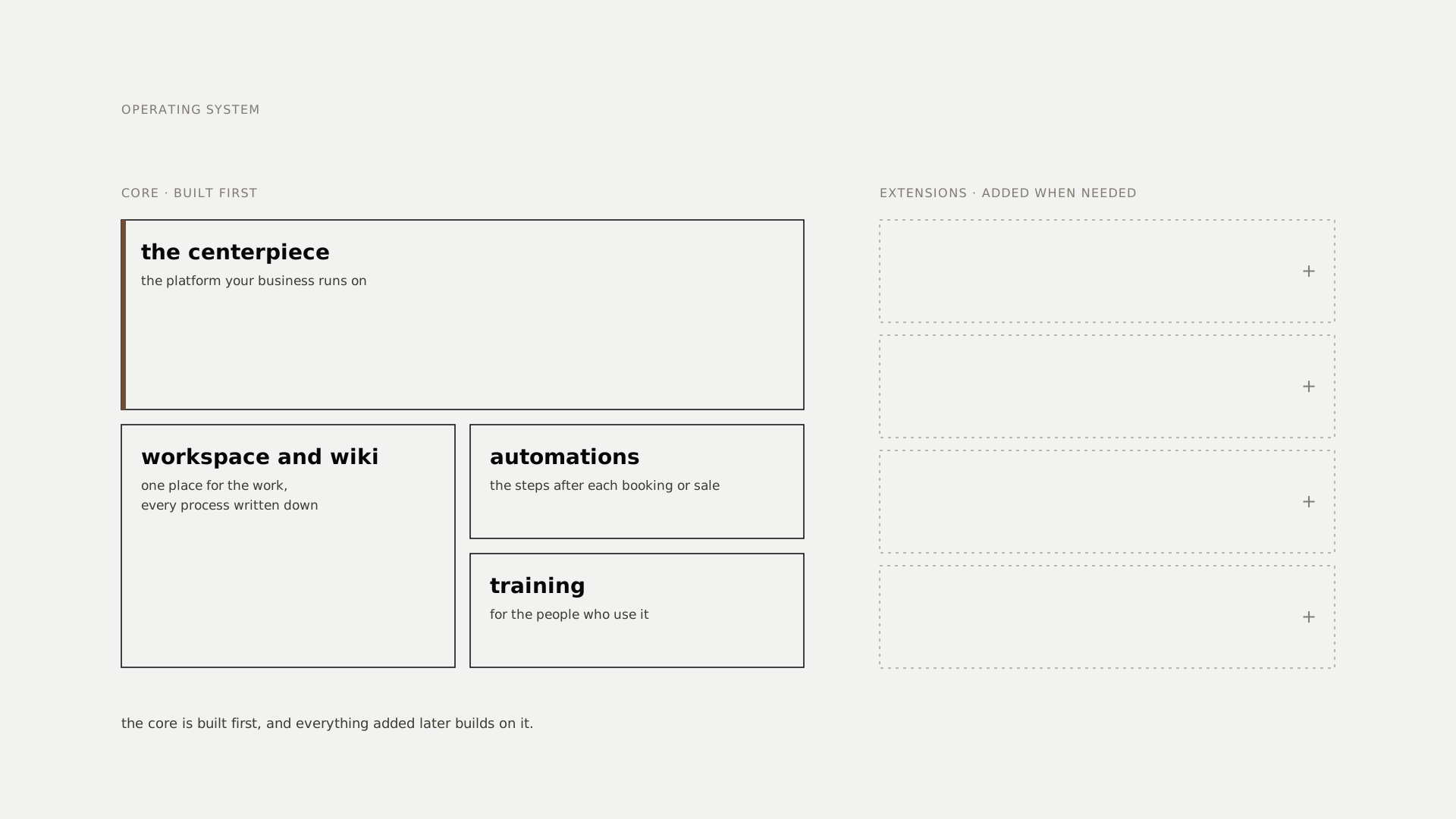
it decides what happens after a booking, a sale or an enquiry and which tool takes care of it, and it is written down, so it keeps working when the person who knows how everything fits together is on holiday. every operating system starts with a blueprint, is built around a core and grows with modules.

01
the blueprint
the plan, before anything gets built.
the blueprint starts with the tools and processes you already have. it decides what the centerpiece of your system is, which tools stay, which get replaced and in which order everything is built, so nothing gets built before it is agreed.
02
the core
what every operating system needs to work.
the core is built first, in every operating system, and shaped around your kind of business. everything added later builds on it.
03
the centerpiece
built for your kind of business
for hospitality, one booking calendar for every channel. for institutes and companies, a sales and course platform with payments.
04
workspace & wiki
one place for the work, in notion by default, with every recurring process written down, so the business does not depend on one person’s memory.
05
automations
the steps that should follow a booking, a sale or an enquiry happen without anyone moving them along.
06
training
a session for the people who work with the system and a follow-up once they have used it, so the questions no longer go to one person.
06
handover
when the core is finished, it is documented, tested and handed over. it belongs to you, including every account and every page in the wiki, and whatever already worked before usually stays in place.
module
crm
a standard crm chosen, set up and filled with your existing contacts, or a custom one where nothing standard fits.
module
communication
email, invoices and internal routing, so every message reaches the right person without being forwarded.
module
website
a website connected to the system, so every enquiry goes straight to where it is handled.
module
afterwards
care keeps the system running and up to date, cancellable every month.
modules
crm
a standard tool chosen (or directly built for your needs), set up and migrated, or a custom one where nothing standard fits.
communication
email, invoices and internal routing, so every message reaches the right person without being forwarded.
website
up to five pages in one language, connected to the system.
afterwards
care keeps the system running and up to date, cancellable every month.
icon villa
one house on five booking platforms, run from a single backend that closes a date everywhere the moment it is booked.
bookings are up 35 percent compared to the year before (tracked).
bodywork instiute
moved off one platform onto ten connected tools over two years, without the business going quiet for a single week.
FAQ
01
do i have to move everything to notion?
02
what happens to the tools i already use?
03
who owns the system?
04
what happens after the build?
05
will my team know how to use it?
Contact form
This is the simplest contact form. To position it to the left or right, simply add an additional column
how should we reply?
Select one or more options
what should change
budget for the first six months
Select one or more options
when should it start?
Select one or more options
first name
Phone
how should i reply?
Select one or more options